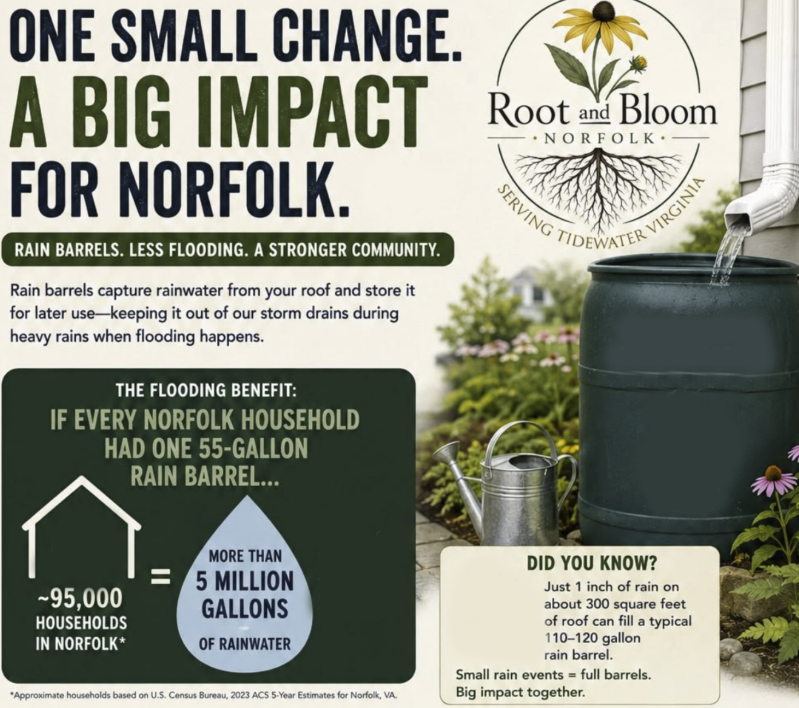
When we think about preparing our homes for heavy rain, flooding, and summer heat, we don't always think about something as simple as a rain barrel.
But a rain barrel can do a lot more than provide free water for your garden. It can help slow stormwater, reduce pressure on drainage systems, conserve drinking water, and give your household an extra source of water when you need it.
For communities like ours in Tidewater Virginia, where heavy rain and flooding are increasingly part of the landscape, capturing rain where it falls is a small action that can make a meaningful difference.
🌧️ Rain Barrels Can Help Reduce Stormwater Flooding
During a heavy storm, rainwater rushes off roofs, driveways, sidewalks, and other hard surfaces. When too much water enters the drainage system at once, it can contribute to overwhelmed storm drains and localized flooding.
A rain barrel temporarily captures some of the water coming off your roof instead of allowing all of it to immediately run into the stormwater system.
Once the storm passes, you can slowly use that stored water on your landscape.
Think of it as giving the rain somewhere to go before it becomes runoff.
One rain barrel won't solve flooding by itself, but thousands of homes capturing and managing rainwater can become part of a larger community resilience strategy.
🌱 Free Water for Your Plants During Summer Heat
Summer gardens can require a surprising amount of water, especially during periods of heat and drought.
Instead of using treated municipal water every time your plants need a drink, you can use the rain you've already collected.
Rainwater is particularly useful for:
- Native plants and established landscapes
- Vegetable gardens
- Flower beds
- Container plants
- Newly planted trees and shrubs
- Rain gardens and other landscape projects
Using stored rainwater can help reduce your household water use and potentially lower your water bill during the summer.
And there's something pretty satisfying about watering your garden with water that fell from the sky for free. 🌿
🚨 Rain Barrels Are Also Useful in an Emergency
A rain barrel can provide an additional source of non-potable water during an emergency or temporary water interruption.
Stored rainwater can potentially be used for things such as:
- Watering plants
- Flushing toilets
- Cleaning outdoor surfaces
- Other uses where potable drinking water isn't required
If you're storing water for emergency purposes, remember that water collected from a roof is not automatically safe to drink. Keep your rain barrel clean and clearly distinguish non-potable water from your household drinking-water supply.
For emergency preparedness, a rain barrel isn't a replacement for properly stored drinking water—but it can provide an additional water resource when you need it.
🦟 Don't Forget the Mosquitoes: Use BTI and a Screen
One of the most important things to think about when installing a rain barrel is mosquito prevention.
Mosquitoes can lay eggs in standing water, so your rain barrel should have a tight-fitting screen or mosquito-proof inlet that keeps adult mosquitoes from getting inside.
We also recommend using BTI (Bacillus thuringiensis israelensis) according to the product directions. BTI is a naturally occurring biological control that targets mosquito larvae while being designed for use around other organisms.
Think of it as a simple two-part strategy:
Screen it + treat the water with BTI.
You can read more about using BTI for standing water in our [mosquito-control guide].
💧 Rain Barrel Setup Tip: Think About the Nozzle Height
Here's a mistake that's easy to make when installing a rain barrel:
Don't put the spigot/nozzle too high.
It might seem convenient to place the nozzle higher up on the barrel, but there's a catch—you'll never be able to completely empty the barrel without tipping it over.
Instead, consider installing the spigot relatively low.
Even better, put the barrel on a stable stand and position the nozzle low enough that you can slide a bucket or watering can underneath it.
That gives you enough clearance to collect the water while still allowing the barrel to drain almost completely.
A stand also gives you a little more gravity pressure, which can make filling a watering can much easier.
⛰️ Remember: Water Runs Downhill!
This is another important consideration when planning your rain barrel system.
If you're connecting a hose directly to the barrel, remember:
Water runs downhill.
A rain barrel isn't going to magically push water uphill through a hose.
If your garden is uphill from the barrel, you'll generally need a pump to move the water uphill.
Before installing your barrel, think about where you actually want to use the water. Sometimes positioning the barrel strategically near the garden is much easier than trying to move water across the yard later.
🌧️ One Barrel Is Good. More Than One Is Better.
If you have the space, consider installing multiple rain barrels.
Once your first barrel fills, additional barrels can be connected together so you can capture more of the water coming off your roof.
A linked system allows you to increase your storage capacity without needing one enormous tank.
For example:
Downspout → Rain Barrel #1 → Rain Barrel #2 → Rain Barrel #3
The more water you can temporarily capture, the less water immediately becomes runoff during a storm.
And when the rain stops, you have more water available for your landscape.
🌿 Rain Barrels Are One Piece of a Bigger Resilience Strategy
At Root & Bloom, we believe resilient communities are built through lots of small, practical actions.
Native plants.
Rain gardens.
Trees.
Healthy soil.
Rain barrels.
Pollinator habitat.
Reducing unnecessary lawn and hardscape.
Each one helps us work with nature instead of constantly fighting it.
A rain barrel won't prevent a major flood—but it can help capture rainwater, conserve resources, support your landscape, and give your household another tool to use when conditions get difficult.
The goal isn't to control every drop of rain. It's to slow it down, capture what we can, and put it to work. 🌧️🌱
🌱 Root & Bloom Tip
If you're installing a rain barrel this year, don't think of it as just a gardening accessory.
Think of it as a small piece of neighborhood resilience infrastructure.
One home captures a little rain.
A neighborhood captures a lot.
And that's how small changes can add up.